
Introducing Parent-Managed Accounts on WhatsApp: What It Means for Safety and Messaging
Messaging apps have become an essential part of everyday communication. Families, friends, businesses, and communities rely on them to stay connected instantly across the world.
Parent-Managed Accounts on WhatsApp represent a new step toward making this communication safer for younger users while still allowing them to stay connected with trusted contacts.
As more children gain access to smartphones, concerns around online safety, privacy, and responsible digital interaction continue to grow. Parents want their children to enjoy the benefits of digital communication without being exposed to online risks such as strangers, inappropriate content, or cyberbullying.
To address these concerns, WhatsApp, has introduced a new feature that allows parents and guardians to supervise how younger users interact on the messaging platform. This system gives families more control over contacts, group participation, and privacy settings.
The new feature is designed specifically for pre-teens under the age of 13, allowing them to communicate with family members and approved contacts while maintaining a secure and controlled messaging experience.
In this guide, we will explore how Parent-Managed Accounts on WhatsApp work, the key features they introduce, and why this update is an important step toward safer messaging for young users.
What Are Parent-Managed Accounts on WhatsApp?
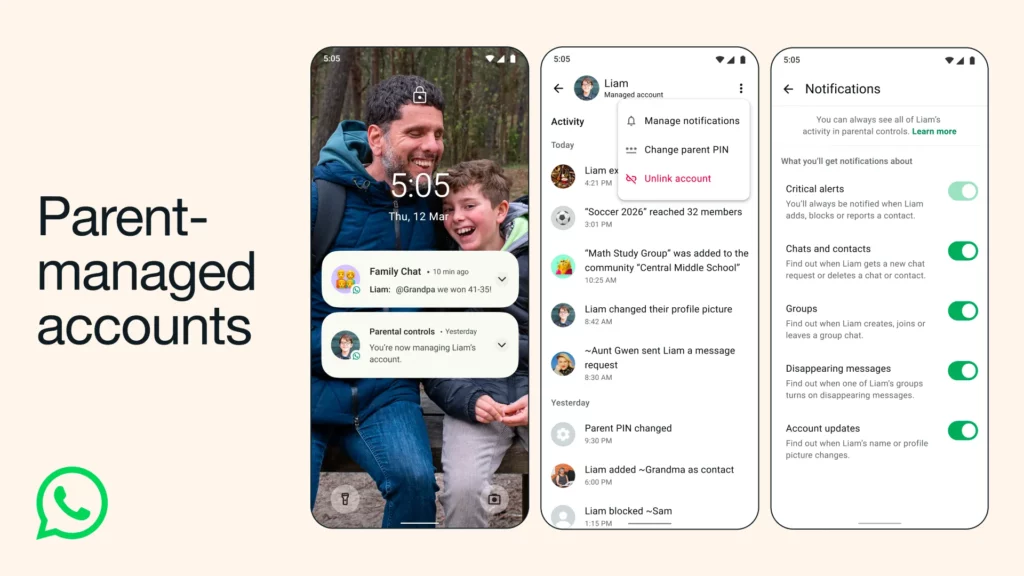
Parent-Managed Accounts are a new type of WhatsApp account created specifically for younger users and controlled by a parent or guardian.
Instead of allowing children unrestricted access to all features of the messaging platform, these accounts come with built-in parental controls that allow adults to guide and monitor how the child uses the app.
Parents can decide:
- Who can contact the child
- Which groups the child can join
- How privacy settings are configured
- Whether message requests from unknown users should be accepted
These accounts are designed to ensure that young users can communicate safely without being exposed to unnecessary risks online.
Why WhatsApp Introduced Parent-Managed Accounts
The introduction of Parent-Managed Accounts comes at a time when governments, educators, and families are increasingly concerned about the impact of social media and messaging platforms on children.
Several factors influenced this decision:
#1. Increasing Smartphone Access Among Kids
More children are getting smartphones earlier than ever. Many parents want their children to stay connected with family but also want to ensure safe communication.
#2. Growing Concerns About Online Safety
Parents worry about issues such as:
- Online predators
- Cyberbullying
- Exposure to harmful content
- Contact from strangers
Parent-Managed Accounts help reduce these risks by limiting who can interact with younger users.
#3. Global Pressure on Tech Platforms
Governments around the world are pushing tech companies to improve child safety online. Messaging platforms are now under greater pressure to provide tools that protect minors.
Key Features of WhatsApp Parent-Managed Accounts
The new system introduces several safety-focused features designed to give parents greater control over their child’s digital communication.
Below are some of the most important features.
#1. Messaging and Calling Only
Parent-Managed Accounts are intentionally limited to basic communication.
Children using these accounts can:
- Send and receive messages
- Make voice calls
- Make video calls
However, several standard WhatsApp features are not available, including:
- Status updates
- Public channels
- AI features
- Location sharing
These limitations help create a simpler and safer messaging environment for younger users.
#2. Parent Control Over Contacts
One of the most important safety features is contact approval.
Parents can decide:
- Who is allowed to message their child
- Whether new contacts can be added
- If unknown contacts should be blocked
This ensures that children only communicate with trusted individuals.
Parents also have the ability to review message requests from unknown numbers before allowing the conversation to continue.
#3. Group Participation Monitoring
Group chats can sometimes expose users to people they do not know.
With Parent-Managed Accounts, parents can control:
- Which groups a child joins
- Whether group invitations should be accepted
- Who manages the group
Parents can also see information about a group before approving membership.
#4. Activity Alerts for Parents
WhatsApp has introduced optional activity notifications for parents.
Parents can receive alerts when:
- A new contact is added
- A group is joined or left
- A contact is blocked or reported
- A new chat request is received
These alerts help parents stay informed about their child’s activity on the platform.
#5. Secure Parent PIN Protection
All parental settings are protected by a six-digit PIN.
This means:
- Children cannot change privacy settings
- Safety restrictions cannot be removed
- Contact permissions remain under parental control
Only the parent or guardian who set up the account can modify these settings.
#6. Separate Folder for Unknown Messages
Messages from unknown contacts do not immediately appear in the child’s main chat list.
Instead, they are placed in a separate message request folder.
This folder is protected by the parent’s PIN, ensuring that:
- Suspicious messages are reviewed first
- Children are not exposed to strangers without supervision
#7. End-to-End Encryption Remains
Despite the added parental supervision, WhatsApp maintains its core privacy technology.
All messages and calls remain protected by end-to-end encryption, meaning:
- Messages cannot be read by WhatsApp
- Third parties cannot access conversations
- Even parents cannot read private chats
This ensures the balance between safety and personal privacy.
How Parents Can Set Up a Parent-Managed Account on WhatsApp

Setting up a Parent-Managed Account is designed to be simple but secure.
The process generally includes the following steps:
Step 1: Use Both Devices
The parent must have their own smartphone and the child’s smartphone nearby.
Step 2: Link the Accounts
The devices are connected during setup using a verification process, often involving a QR code.
Step 3: Configure Privacy Controls
Parents then configure:
- Contact permissions
- Group participation
- Activity alerts
- Privacy settings
Step 4: Set a Parent PIN
Finally, the parent sets a six-digit PIN to lock the safety settings.
This ensures that only the parent can change the account’s restrictions.
What Happens When the Child Gets Older?
WhatsApp understands that children eventually grow into regular users.
Once a child reaches the appropriate age, the app may notify them that the account can transition into a standard WhatsApp account with full features.
Parents may also have the option to delay this transition for a period of time if they prefer to keep supervision active.
Why This Feature is Important for the Future of Messaging
Parent-Managed Accounts represent a significant step toward responsible digital communication for younger users.
This feature offers several long-term benefits:
Safer Digital Introduction
Children can learn how to communicate online in a controlled environment.
Reduced Exposure to Strangers
Parents control who can contact the child.
Balanced Privacy
Encryption ensures conversations remain private.
Parental Guidance
Parents remain actively involved in their child’s online experience.
What This Means for Businesses and Marketers
Although this feature is designed for families, it also highlights an important trend in the messaging industry.
Messaging platforms are increasingly prioritising:
- Privacy
- User safety
- Responsible communication
For businesses and marketers using WhatsApp, this means:
- Ethical messaging practices will become more important
- Consent-based communication will be essential
- Transparency and trust will define successful messaging strategies
Platforms are moving toward safer ecosystems, and businesses must adapt accordingly.
Conclusion
The introduction of Parent-Managed Accounts on WhatsApp shows that messaging platforms are evolving to address the needs of younger users and their families.
By allowing parents to supervise contacts, group participation, and privacy settings, WhatsApp is creating a safer digital environment for pre-teens while still maintaining the privacy and security the platform is known for.
As digital communication continues to grow, features like these will play an important role in ensuring that messaging remains safe, responsible, and accessible for everyone.
